An Affidavit of Good Faith is a sworn statement declaring that a party acted in good faith in a transaction — with honest intent and without knowledge of any defect in title, adverse claim, or encumbrance affecting the subject property or contract. It is required in property sales and mortgage transactions to establish that the buyer or mortgagee is a buyer or mortgagee in good faith and for value, and is also used in certain court proceedings where a party's intent must be placed on record.
Legalia automates the drafting. This tutorial walks you through the complete process of generating a notary-ready Affidavit of Good Faith online — from logging in to saving a print-ready PDF — in five steps.
Generate Your Affidavit of Good Faith — Free
No credit card required. Draft, preview, and print a notary-ready Affidavit of Good Faith for property sales, mortgage transactions, or contract proceedings — Philippine format, correct jurat included.
Generate Free with LegaliaWhat you need before you start
- A free Legalia account — sign up here
- The affiant's full name, civil status, and address (typically the buyer or mortgagee)
- The type of transaction (sale, mortgage, or other) and a description of the property or subject
- The date of the transaction and the other party's name
Step 1: Log In and Open Your Dashboard
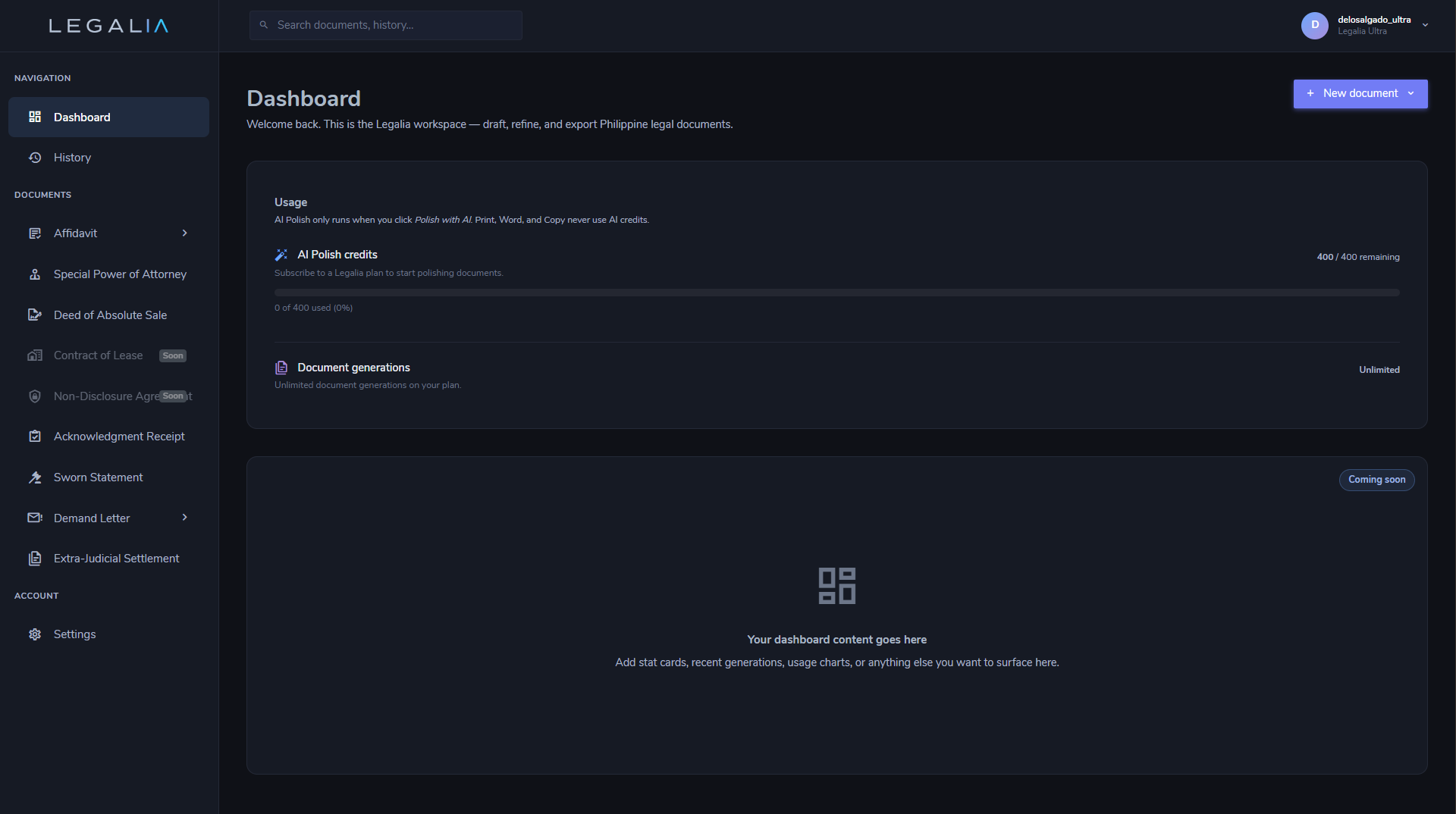
Sign in to your Legalia account at https://legalia.ph. After logging in you will land on the document library dashboard, which lists all available document types grouped by category — Affidavits, Contracts, Deeds, and more.
Step 2: Select Affidavit of Good Faith
Under the Affidavits category, click Affidavit of Good Faith. The document editor opens in a two-panel layout:
- Left panel — the guided form with all required and optional fields
- Right panel — the live document preview, updated in real time
Every change you make in the form is immediately reflected in the preview — you always see exactly what will print.
Step 3: Fill In the Form
Complete the fields on the left panel. The form is divided into three sections:
Affiant Information
| Field | Notes |
|---|---|
| Full Name | Exactly as it appears on a government-issued ID — typically the buyer or mortgagee |
| Civil Status | Single / Married / Widowed / Legally Separated |
| Address | Complete residential address including barangay, city/municipality, and province |
Transaction Details
| Field | Notes |
|---|---|
| Type of Transaction | Select Sale, Mortgage, or Other — the declaration language adjusts to the transaction type |
| Property / Subject Description | Brief description of the property or subject matter — e.g., "a parcel of land covered by TCT No. ___" or "a residential condominium unit at ___" |
| Date of Transaction | Date on which the sale, mortgage, or agreement was executed |
| Other Party's Name | Full name of the seller, mortgagor, or counterparty in the transaction |
Good Faith Declaration
| Field | Notes |
|---|---|
| Purpose | State where or why the affidavit is being submitted — e.g., "for registration purposes with the Registry of Deeds" or "as required in support of the transfer of title" |
Step 4: Review the Live Preview
The right panel shows the document exactly as it will print. Review the full text carefully — especially the affiant's identity, the transaction description, the good faith declaration, and the jurat block at the bottom.
The following optional tool appears at the top of the preview panel:
- Polish with AI — rewrites the narrative paragraphs in formal legal Philippine English while preserving all facts. Particularly useful for ensuring the good faith declaration meets the standard expected by the Registry of Deeds or the court.
Step 5: Print or Save as PDF
When the document looks correct, click the Print button in the action bar. Your browser's print dialog opens.
- To print on paper: select your printer and click Print.
- To save a PDF: change the Destination to Save as PDF. The output is a clean document with no UI chrome, headers, or footers — formatted for standard 8.5×11 or A4 paper with correct margins and line spacing for notarial use.
Bring the printout to your commissioned notary public for the affiant's oath and signature. Attach it to the corresponding deed or contract before filing with the Registry of Deeds or the court.
That is the complete workflow — from opening the dashboard to a notary-ready Affidavit of Good Faith.
Generate Your Affidavit of Good Faith — Free
No credit card required. Draft, preview, and print a notary-ready Affidavit of Good Faith for property sales, mortgage transactions, or contract proceedings — Philippine format, correct jurat included.
Generate Free with Legalia